Confession from a Time of Haste

whiterabbit-johntenniel-1890-detail

I can’t speak for my students, but this is a rough point in the semester for me. We’re deep enough into the autumn that the start-of-term excitement is over in all my courses. But we’re not far enough into the semester that any of the provocative large-scale arguments I’m making have come together yet. I haven’t seen many epiphanies in class.

Moreover, with two new preps outside my areas of specialty (for a total of four different courses), I don’t have much time for the routine preparation work that makes the most familiar courses run smoothly. Covering topics I should know very well, I’ve caught myself making sloppy errors, losing my train of thought in class, framing content in ineffective ways, and running out of time to cover everything I’ve promised. I’ve even called students by the wrong names and forgotten which homework readings I’ve assigned them.

The students whom I suspect this hurts the most are those undergraduates in my introductory survey courses who are the least knowledgeable or emotionally invested in history. This semester is not going to be one of my best, I think, where they are concerned. That makes me deeply ashamed.

I have been through such moments before, however, and I know this one will pass. Many students will do well. (Actually, I think very highly of my students this semester, though I usually say that.) And the confusion and angst I’m feeling are a sign of growth. They reflect time spent on new subjects and skills, and in some cases, they also reflect the risks I’ve taken in trying new approaches with uncertain results.

I’m recording this not to complain (or to parade my shortcomings before an audience), but to remember. I want to write down that this is part of teaching, too.

_______________

Image:  Detail of John Tenniel, “The White Rabbit,” illustration in Lewis Carroll, The Nursery Alice (London: Macmillan & Co., 1890), courtesy of the British Library. Public domain.
 

Narrative Methods: Finding Suspense Points

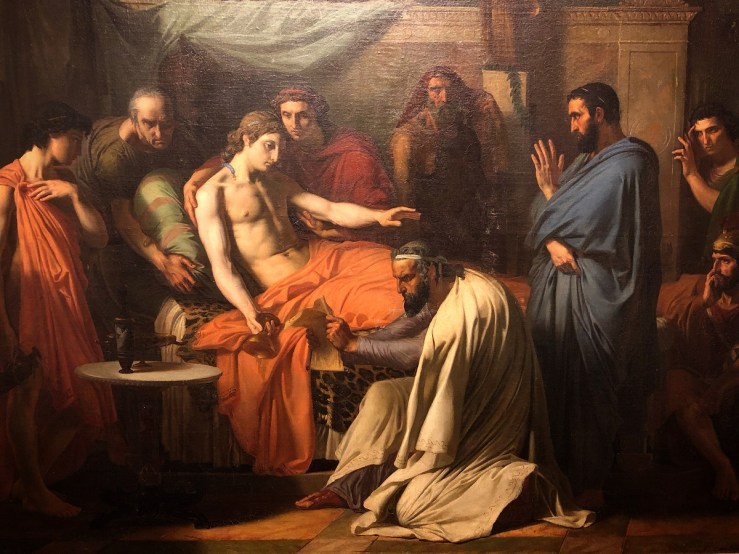
Henri Augustin Gambard, La maladie d'Alexandre, 1846. Public domain. La Salle University Art Museum.

When I started teaching history, I had to figure out quickly how to turn narrative-shaped factual information into interesting true stories for the classroom. One of the most powerful tools I discovered was what (borrowing a term from other disciplines) I’ll call the pregnant moment: a mental scene that sums up action or change in an ambiguous way, allowing the student’s imagination to roam while impelling the student to reckon with the implied before-and-after of the scene.

Pregnant moments not only build suspense into the narrative structure of a lesson. They also provide rich opportunities for embedding active learning in a lecture, since they let you invite students into a scene to talk together about the possibilities it implies.

Sometimes you can create this kind of suspenseful moment just by setting a scene in a general way—by inviting students to imagine themselves, for example, as members of a community who have just encountered a strange invader or whose lives are about to be transformed by a new technology or idea, and asking them to talk through what’s likely to happen next.

But it can be especially effective to use primary sources to create a pregnant moment for students based on a more specific interlude in human experience.

Continue reading “Narrative Methods: Finding Suspense Points”

What’s a Good Small-Group Activity to Illustrate the Concept of a False Dichotomy?

America's most movie-friendly classroom

An interesting new study conducted at Harvard University and published in Proceedings of the National Academy of Sciences finds that undergraduates in introductory physics courses learn more in classrooms that employ active-learning instruction methods (specifically, problem-solving in small groups) than students taking notes on “passive” lectures—but think they learn less. The researchers propose that this discrepancy between actual and perceived learning happens because active learning requires more effort on students’ part; it feels frustrating or inefficient. They also warns that this means that relying on student evaluations of teaching could lead instructors to use “inferior (passive) pedagogical methods” in their quest to achieve the popularity of “superstar lecturers.”

The study (full version in PDF format here) seems excellent in design and careful in its conclusions. Unfortunately, Harvard has publicized it with a news article that draws a tiresome false dichotomy between lectures and active learning, going so far as to quote the peer-instruction proponent Eric Mazur—who helped with the study—this way:

‘This work unambiguously debunks the illusion of learning from lectures,’ he said. ‘It also explains why instructors and students cling to the belief that listening to lectures constitutes learning.’

Of course, the study does no such thing as Mazur’s first claim.

Continue reading “What’s a Good Small-Group Activity to Illustrate the Concept of a False Dichotomy?”