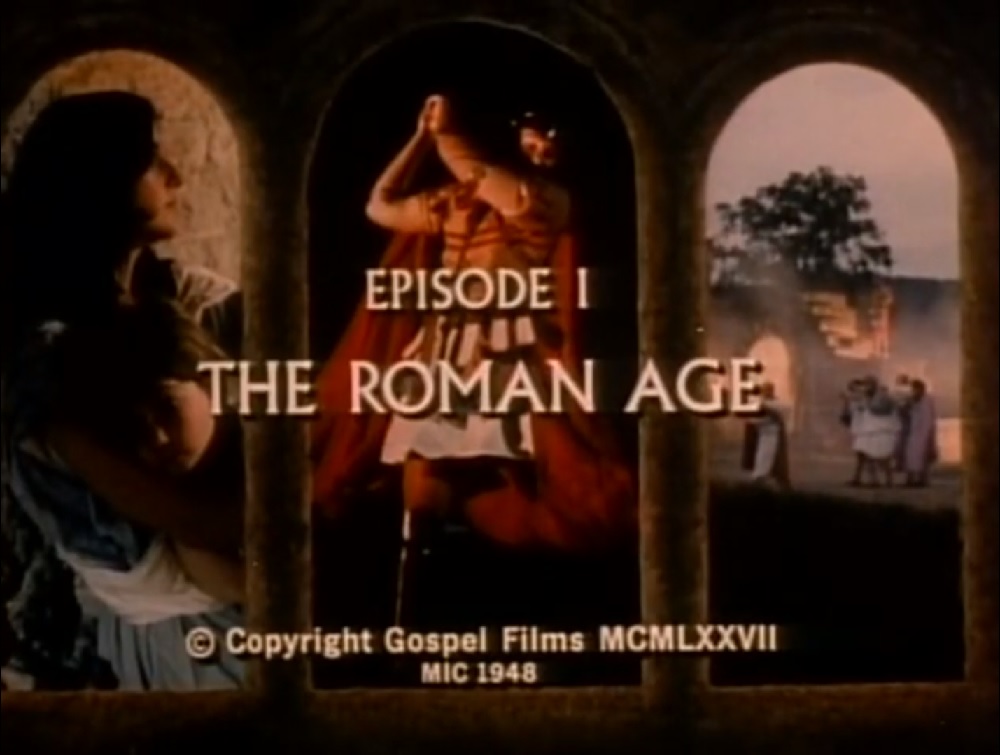
This is the first regular installment in a series of posts as I rewatch a 1977 documentary film series called How Should We Then Live? If you haven’t already seen it, I strongly recommend starting with the project introduction. Today’s episode is “The Roman Age.” (Because I’m still introducing key aspects of the overall series, today’s post is significantly longer than most will be. I hope you’ll bear with me.)
Last week, we talked about why Francis Schaeffer’s 1977 film series How Should We Then Live is important. Now let’s settle in to watch the first episode.
From the moment I began rewatching How Should We Then Live for this blog series, three things stood out.
This is the beginning of a series of weekly posts as I rewatch a 1977 documentary film series called How Should We Then Live? The first regular installment was posted the following Thursday.
In the years after Time Magazineprofiled him as a missionary to the “painters, writers, actors, singers, dancers and beatniks” of Europe in the 1960s, Francis A. Schaeffer IV cut a striking figure.
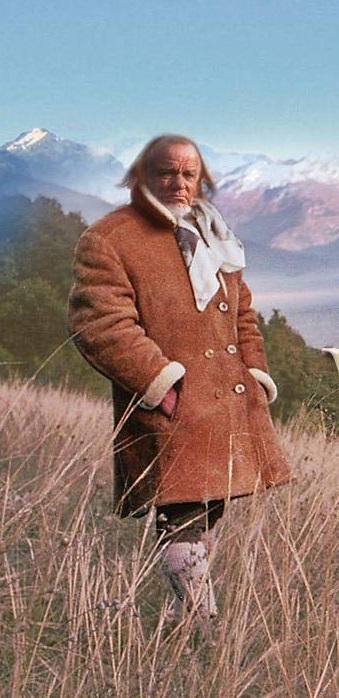
Francis Schaeffer as he appears in a composite image on a recent cover for the film series
By the late 1970s, wearing knickerbockers and turtlenecks, with collar-length hair and a bushy goatee, Francis Schaeffer looked a bit like a shepherd who had come inside for a poetry reading—which I suppose is, metaphorically speaking, precisely what he was. He spoke in a soft, hoarse tenor. His accent had become unplaceably transatlantic without quite losing the sound of working-class Germantown, Philadelphia. In photographs and films, he always looked a bit sad.
And, of course, Francis Schaeffer had made a new life in French-speaking Switzerland. That was a very long way, in more than one sense, from the fundamentalist Presbyterian churches that had provided his early intellectual formation in America’s future rust belt.
Though he struggled with incapacitating depression and an explosive temper, Francis Schaeffer, together with his wife Edith and their children, had opened their home to a little international community, aiming to share the life of the mind. Established in 1955, L’Abri, meaning “The Shelter,” had become a kind of Protestant ashram, combining aspects of a youth hostel, a utopian community, and a religious study group.
There, in chalets in the foothills of the Swiss Alps, the Schaeffers offered hospitality—but also, as they saw it, uncompromising lessons in the truth—to intellectual wanderers. They promised “honest answers to honest questions,” which became a catchphrase. For if “Christianity is truth,” Francis reasoned in 1974, it must have answers about “every aspect of life”—but this required “that we have enough compassion to learn the questions of our generation” in the first place.
By the 1980s, this paradoxical Pennsylvanian in Switzerland—whom his own daughter would jokingly call “a very odd man”—had become one of the most important writers and speakers in America’s evangelical movement. By extension, he exercises a crucial influence on U.S. politics to this day. (L’Abri still exists, too, with satellite study centers as far away as Brazil, South Africa, and South Korea. The name, by the way, is pronouced “lah-BREE.”)
Here’s what interests me for the purposes of this blog: Between 1974 and 1977, Francis Schaeffer, a preacher with no relevant academic training, attempted an ambitious interpretation of European cultural history in the form of a documentary film series and a companion book.
In the last few days, several European conversations converged for me in a troubling way.
Historic anniversaries played a role. This Saturday was the anniversary of V-E Day for most western nations. And the next day, which was Victory Day in Russia, Vladimir Putin delivered a speech that western media found threatening. In some pockets of social media, I found scattered debates about how to remember the Soviet Union’s outsized role in Nazi Germany’s defeat. Last Wednesday, meanwhile, had been the bicentenary of Napoléon Bonaparte’s death. Marking that day, Emmanuel Macron laid a wreath at the dictator’s grave, delivering a speech that lightly acknowledged some of Napoléon’s crimes yet also celebrated his “political will” and “taste for the possible”—as if murdering people on a continental scale were a self-actualization exercise.
In the Guardian yesterday, the columnist Kenan Malik—with one eye on recent British debates about how to remember the imperialist-but-antifascist Winston Churchill—brought together various conversations when he implicitly praised Macron’s speech as a refusal “to paint heroes and villains in black and white, to simplify the past as a means of feeding the needs of the present.”
Reading the text of Macron’s speech myself, though, I find that simplifying the past to feed the needs of the present is precisely what the French president was doing.

 Blue Book Diaries