Never Have I Ever … Become a New Teacher


Almost two months after announcing my career transition, it seems appropriate to write an update. Whether to keep blogging at Blue Book Diaries is still an open question. But I’m comfortable describing some of the process of turning a veteran adjunct college professor into a novice high-school teacher.

First, much of my summer has gone to practicalities—figuring out new living arrangements, my new commute, that sort of thing. At the same time, I’ve made sure to relax whenever it’s reasonable. Both teaching and house-moving tend to behave like a gas, not a liquid; either of them will fill any container (of time and mental focus) you provide. If you don’t want to start a new academic year pre-exhausted, you’ve got to make room for rest before you tackle other forms of preparation.

(In other words, I’ve spent more of the summer than usual, not less, going to the mall, the movies, and the beach. And yes, that absolutely has been the right thing to do for the sake of my new students.)

As for teaching itself, the opportunity to reimagine my work has been wonderful. My new courses allow a lot of room for creativity, not least because they’re supposed to be interdisciplinary. Even if they were die-cut history survey courses, though, I would still be thinking hard about my goals for them—and about what ninth and twelfth graders really need from a history class.

The first definite teaching choices I had to make this summer concerned textbooks. Being hired fairly late in the season meant there were only a couple of weeks to decide which books to assign for the new academic year. Choosing these books required not only thinking ahead about course structure but also making judgments about likely student and parent perspectives.

Would a certain book be appropriately challenging for a ninth-grade reader without being overwhelming? Would a certain mix of books allow my students to see their ancestors’ peoples represented in world history? Could I perhaps find a friendlier translation of a certain book-length primary source? The textbook selections I made have already locked me into certain approaches for the whole upcoming year. But a lot of key decisions remain to be made before September.

Throughout the summer, talking with other teachers—often in Zoom meetings and over the phone—has been crucial. Several of my new colleagues, as well as the teacher I’m replacing, have generously shared their time with me, offering advice of many kinds. And I’ve continued talking with old friends about teaching in general, too.

Indeed, emotionally speaking, the best thing about this transitional moment, for me—besides just getting to look forward to teaching new students soon—has been the support shown by other educators. Never before have I had a stronger sense of taking part in a shared educational project.

Of course, I’ve been around long enough to know that no workplace is perfect. But I’ve also been around long enough to know not to take any good thing for granted. And this summer is full of good things.

Winds of Change

A few years ago, I decided it was time to start wrapping up my college teaching career. The circumstances were finally right. I would pursue a different job that I had thought about for a long time. Within a few weeks, I had more or less made up my mind.

That was in February 2020.

You know what happened next. Within a few weeks, all specific planning stopped.

But my goal didn’t change, and for the next three years, I kept working on it, a little at a time.


To make a long story short: I guess it worked.

Late last month, I accepted an offer to teach in the history department at an independent school in the greater New York City area. Starting this autumn, I’ll be a high school teacher.

It’s not clear yet what this will mean for Blue Book Diaries, or how much of the transition I’ll be comfortable discussing here this summer. It may be time to wind down this blog, or maybe it should live on in a new form. I don’t know. In any case, I’m proud and happy.

A New Career for History Majors

Many American humanities professors are worrying about evidence that students are avoiding us. Partly due to the extreme cost of a typical college education today, combined with the economic insecurity of our younger middle class, undergraduates are not only deciding not to major in humanities disciplines like history, but—even more worryingly—are also likely more likely than college graduates in other fields to regret their choice later if they do.

Into this darkness comes a sudden ray of hope: a brand-new career opportunity for history majors. And it’s lucrative!

I think we can expect a rebound in history enrollments once young people realize that studying history can prepare you very well to compete for a rewarding job as the king of England.

I discovered this recently when I heard a BBC radio report that mentioned that the newly elevated Charles III studied archaeology at Trinity College, Cambridge, in the 1960s. Looking into this, I found that Charles had indeed studied archaeology and anthropology at first, but had switched to history for the latter part of his time at Trinity.

Now, I’m not exactly an expert on how subject examinations work at Cambridge, but as I understand it, this meant Charles’s baccalaureate degree was indeed a B.A. in history when he earned it in 1970.

In any case, that’s how the New York Times reported it at the time. Describing “the first university degree to be earned by an heir to the British crown,” the Times noted the following:

The degree awarded, based on examination results, was an honors degree in history, Class 2, Division 2. That is about the average at Cambridge — ‘a good middle stream result,’ as one don put it.

There are three classes of honors degrees, awarded according to grades, and the second class in turn has two divisions. …

The Prince’s tutor, Dr. Denis Marrian, senior tutor at Trinity, was asked whether Charles had been in any trouble as an undergraduate. ‘Nothing went wrong,’ was the reply. ‘In fact, I think you’ll find I have more hair now than I did three years ago.’

According to a recent story in the Guardian, the British monarch’s main income last year (the “sovereign grant,” a sort of royal allowance from the government), amounted to £86.3 million, or $98.2 million. That’s revenue derived from official wealth totaling an estimated £17 billion or so. (The crown owns expensive parts of London, much of the sea floor, the swans, etc.) In addition, the late queen had a private fortune estimated this year at £370 million; presumably much of that has passed to Charles III. Being the monarch also means significantly expanded access to housing in today’s tight market.

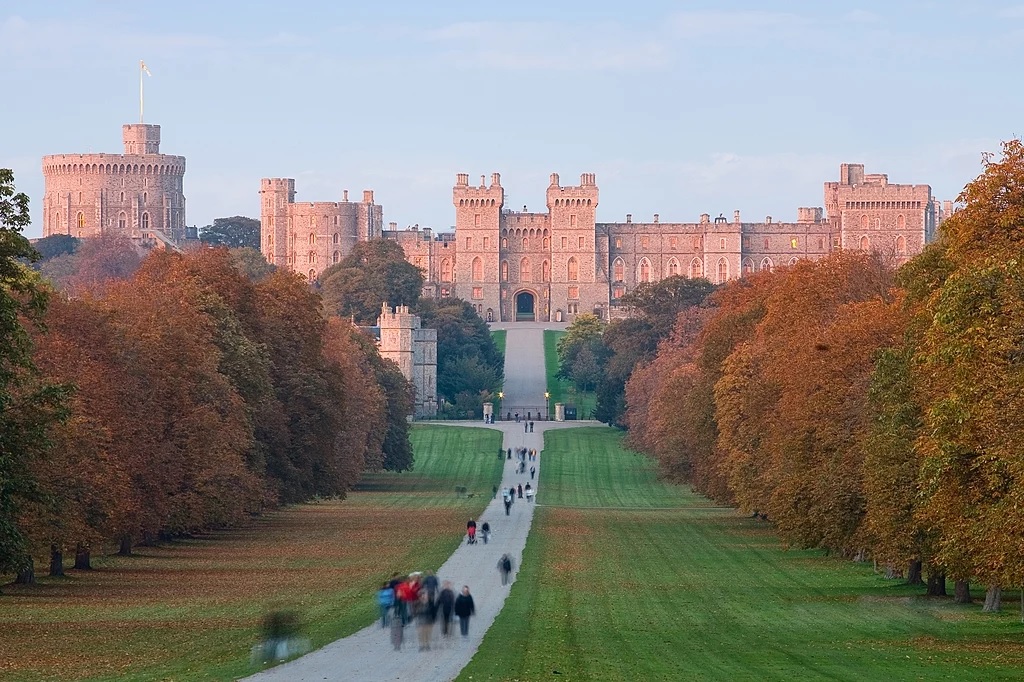
Seen at sunset: Just one of the exciting benefits of a career in history
Photo by David Iliff, 2006 (CC BY-SA 3.0)

I think we can all agree that this means a bachelor’s degree in history, even with only average grades, can be an excellent investment for a student’s future economic security. I trust American colleges and universities won’t overlook this crucial opportunity to publicize the value of what we do.

To be fair, though, it’s a career with limited opportunities for promotion.