American Narratives and Identities: Another Primary Source Activity

Last month, I wrote about how I used four primary sources—images and texts from revolutionary-era America—to introduce students to the concept of “cultural narratives” in my American studies course. Now I’d like to talk about another primary source discussion I found valuable this semester: one designed to shake up students’ mental picture of the United States at the end of the Revolution.

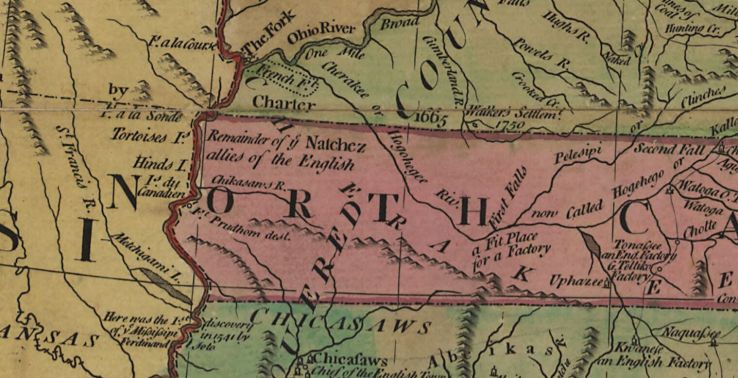
In 1783, around the time the American War was formally ending, the London publisher Carington Bowles released a “new map of North America and the West Indies” that attempted to capture the boundaries and larger context of the newly independent colonies. The Library of Congress has helpfully provided a high-resolution scan of the map, which has an almost alarming wealth of detail.

(To take an example at random: In what it considers western North Carolina, the map shows not only rivers and settlements but also notes about history and future prospects, labeling a “remainder of the Natchez allies of the English,” a putative location for the 17th-century Fort Prudhomme [“dest.”], and “a fit place for a [trading] factory.”)

1783mapofnorthamerica-caringtonbowles

In class, using the classroom computer and projector, I pulled up the map’s webpage.

Continue reading “American Narratives and Identities: Another Primary Source Activity”

History the Aggressor

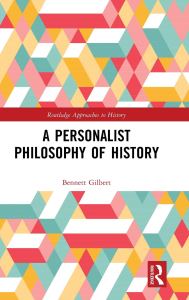
gilbert-personalistphilosophyofhistoryFrom the recipient’s point of view, the past is intrusive. It can be soothing, but not for very long and only at the cost of ignoring its terrible misery and destruction. The history that presents us these quandaries is not merely a propaedeutic to metaphysics. We find that it is history the aggressor. Apart from our fantasies about history, we fight history. We fight over it, and we fight against its influence. In order to be inspired by it—that is, by what past actors have done—we have to fight a way through the difficulties of temporal distance, through the complexities of their circumstances, and through feelings about our own freedom or independence. In this sense, historical experience, whether it comes from disciplinary research or from other ways of engagement, is a battle. And, in turn, by battling with the past we intrude into it. Aggressor history rouses our counter-attack strategy of intrusion into the past. As much as we ‘love’ and enjoy history, it is absolutely necessary to realize that we fight its awful burden. It attacks with its puzzles and invades with its unending causality; we defend with research or data, we counter-attack with theory. The motive for those who hate history and reject the past is deep down close to the motive for those who study and cultivate it.

— Bennett Gilbert, A Personalist Philosophy of History (London and New York: Routledge, 2019), 28

The Power of PowerPoint

As you may recall, I’m a defender of PowerPoint, rightly used. Today I came across a highly entertaining classroom video from Tom Wildenhain, a computer science student at Carnegie Mellon, demonstrating just how much is happening underneath the hood of this program (with hints that there’s more to learn).

Great Impractical Ideas in Computer Science: PowerPoint Programming

Wildenhain’s lecture includes some theory for those who are interested, but mostly it comprises a series of captivating demonstrations, including one where an audience member asks a question that prompts a brand-new discovery. The video is 52 minutes long, and it’s simply charming. (via)

How Did You Learn to Tell Stories in the Classroom?

storyteller-tiepolo

This semester marks seven years since I taught the first college course of “my own”—being solely responsible for writing the syllabus, choosing all the readings, designing all the assignments, and planning all the lectures and activities. I was hired at the last minute. On the first day of class, I didn’t even have password access to the classroom computer yet. The bookstore was still selling my students books that somebody else had chosen, which I didn’t intend to use and didn’t have copies of anyway. I don’t think my university email address had been activated.

I’m not absolutely sure, though, because at this point, I barely remember anything about that semester except a general feeling of panic.

What I do know is that one of my biggest challenges was simply learning to narrate history in the classroom. This was crucial because—in a single-semester U.S. history survey course—my students wouldn’t have a traditional textbook to carry that burden outside of class. (And The American Yawp had yet to be written.) The course’s narrative of U.S. history, all of it, both in the overall course arc and in each topic we covered, had to subsist in whatever I could accomplish in the classroom or through short readings scavenged from different sources and posted online.

I had a fair amount of teaching experience, but almost nothing of that nature. I had never been a gifted storyteller in person. (Not even close!) And to my recollection, despite a fair amount of pedagogical development in graduate school, I had never been provided with any specific instruction or advice relevant to this situation.

That first course … probably wasn’t great.

Even if my last-minute hiring made the need unusually acute, I don’t think my situation then was unique. I can’t speak as much to the experiences of primary- or secondary-level educators, but my sense is that in college, many people trained to teach history (or trained in the many other academic disciplines that also teach historical topics) never get any training in the basic task of building a historical narrative in the classroom until they show up in their own classroom for the first time.

But I want to check whether my intuition is right.

If you’re willing to leave a generous comment on this post (or email me if you need to communicate privately), I’d like to know what your experiences have been as a teacher (primary, secondary, college, university, whatever)—in history or any other field where the need comes up.

  • Did you have any formal training in how to build a historical narrative in the classroom?
  • Is this a problem you’re still trying to solve for yourself?
  • Have you found any instruction books, online courses, etc., helpful?
  • What aspects of storytelling or narrative-focused course organization have been the most challenging for you?
  • If you are a naturally gifted storyteller, have you faced any challenges bringing this skill into an academic setting?

_______________

Image: Detail from Giovanni Domenico Tiepolo, The Storyteller, 1770s. Blanton Museum of Art, Austin, Texas; via Wikimedia Commons. Public domain.