God’s Not Dead, Just Away at College

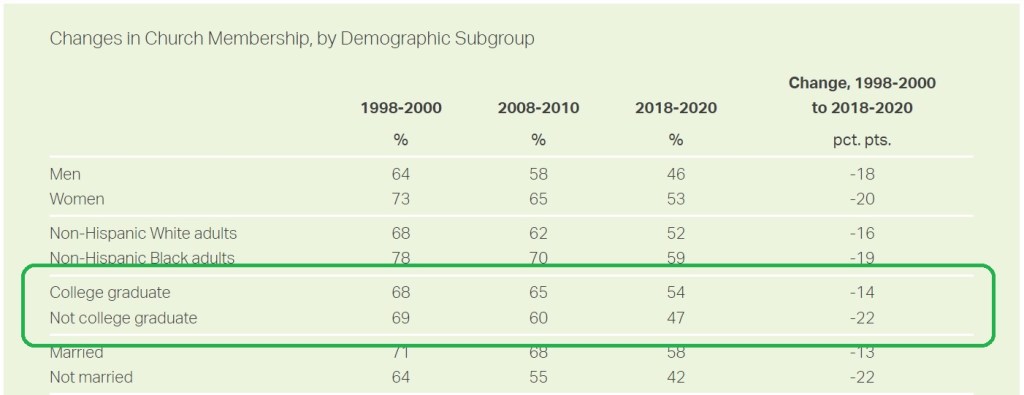
Briefly noting this item from March 2021: Contrary to conventional wisdom, having a college degree makes an American substantially more likely to say they belong to a church, synagogue, or mosque. That’s according to Gallup surveys that have tracked religious affiliation over time.

Edited chart provided by Gallup

The religious affiliation gap between college graduates and non-graduates, which didn’t exist two decades ago, appears to be widening rather than closing.

As I’ve tried to show here at Blue Book Diaries many times, the conventional wisdom about higher education’s ideological effects in the United States is profoundly broken. That is due in no small part to the work of cynical pundits and professional surrealists, many of whom were happy to receive the benefits of education at elite universities themselves.

The relationship between higher education and religious belief is complicated, but simplistic narratives about supposed religious hostility and atheism in college don’t capture the typical American student’s experience.

Inner and Outer Problems

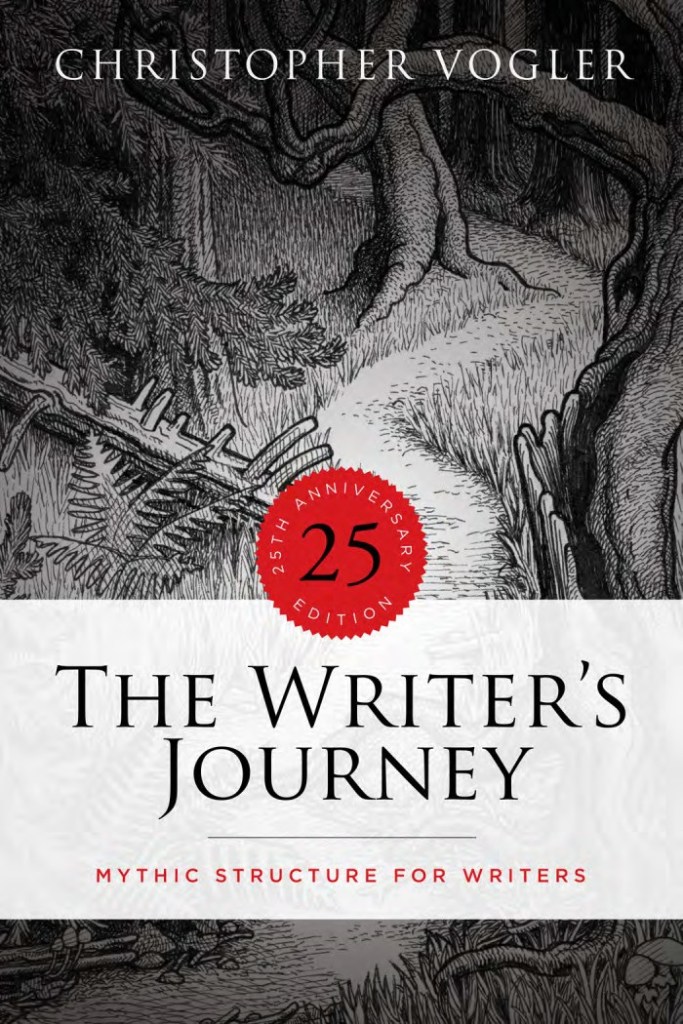
Every hero needs both an inner and an outer problem. In developing fairy tales for Disney Feature Animation, we often found that writers, in the early drafts, would give the heroes a good outer problem: Can the princess manage to break an enchantment on her father who has been turned to stone? Can the hero get to the top of a glass mountain and win a princess’s hand in marriage? Can Gretel rescue Hansel from the Witch? But sometimes writers neglected to give the characters a compelling inner problem to solve as well.

Characters without inner challenges seem flat and uninvolving, however heroically they may act. They need an inner problem, a personality flaw or a moral dilemma to work out. They need to learn something in the course of the story: how to get along with others, how to trust themselves, how to see beyond outward appearances. Audiences love to see characters learning, growing, and dealing with the inner and outer challenges of life.

—Christopher Vogler, The Writer’s Journey: Mythic Structure for Writers, 4th ed. (Studio City, Ca.: Michael Wiese Productions, 2020), 105

History Wars: Views from Five Illinois High School Teachers

This summer, at Illinois State University, the historian Andrew Hartman organized a graduate seminar around the topic of American history survey courses. He focused especially on “the history wars”: contemporary political debates about how U.S. history should be taught. Most of his students were teachers already working in secondary schools.

Five of these high school history teachers wrote essays that now have been published in the new (fall 2021) issue of Teaching History: A Journal of Methods. Introducing these essays, Hartman explains the assumption and the common reading that underpins the five teachers’ work:

One of the most powerful forms of constructing the American history narrative can be found in surveys of U.S. history, books assigned in high school and college classrooms that sometimes even attract readers beyond the classroom. In short, the course objective was to think deeply about the construction of the narrative of American history by reading, analyzing, and critiquing five of the most popular and intriguing U.S. history surveys, written from a diverse range of perspectives and with distinct objectives. We read, in the following order: Wilfred McClay, Land of Hope: An Invitation to the Great American Story; Howard Zinn, A People’s History of the United States; Jill Lepore, These Truths: A History of the United States; Eric Foner, The Story of American Freedom; and Greg Grandin, The End of the Myth: From the Frontier to the Border Wall in the Mind of America. We also read the 1619 Project and the 1776 Report.

The teachers’ contributions to this forum are:

Using World History Case Studies in My Mediterranean History Survey, Part II: Method and Results

Before the current semester began, I described my plan to assign small-group projects in Honors 121, an introductory history course. As I explained then, I hoped that this assignment would leverage the power of teaching as a way of learning. I also hoped it would deepen students’ investment in the course and would serve as a very basic introduction to library research. Moreover, I hoped the assignment would help students look beyond the course’s original framing as part of their honors program’s introduction to “the western tradition,” using it as a window into the history of the wider world.

We followed through on this plan. Now that the semester is winding down, it seems appropriate to describe what happened.

Continue reading “Using World History Case Studies in My Mediterranean History Survey, Part II: Method and Results”

Tennessee’s First CRT Complaint: Kids Are Learning About the Civil Rights Movement

The Nashville Tennessean reported yesterday that the Tennessee Department of Education recently dismissed its first official complaint about a reported violation of the state’s new law banning supposed “critical race theory” from schools. The law prohibits Tennessee public and charter schools from teaching history that makes students feel “discomfort” about their race or sex.

The department dismissed the complaint, which was filed this summer, on a technicality: It referred to teaching that happened before the law took effect.

The details of the complaint, however, are instructive.

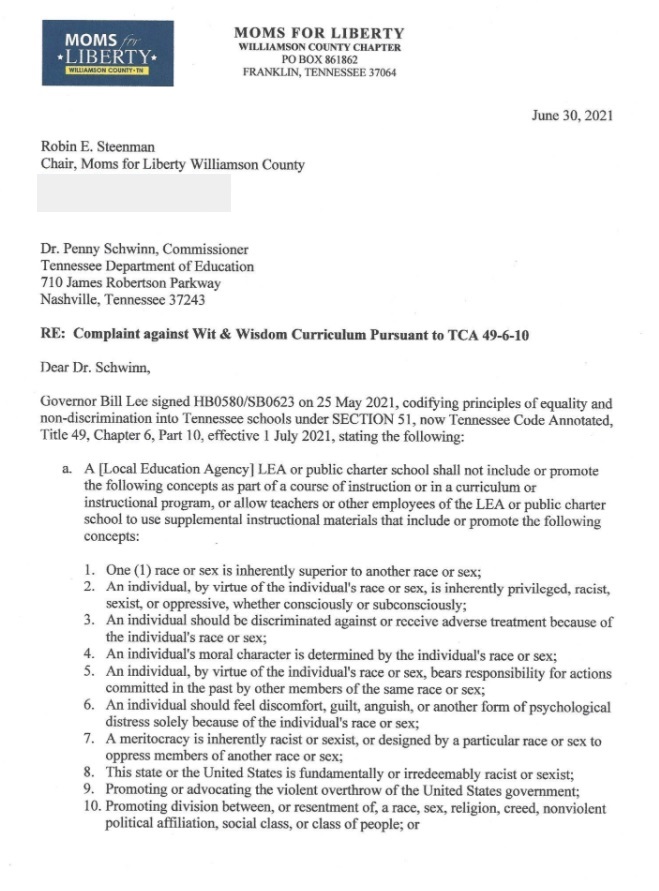
Simply put, the “Moms for Liberty” chapter in Williamson County, near Nashville, alleged that their county’s public schools illegally taught children about the Civil Rights Movement last year.

If you don’t believe me, look at the actual complaint letter, which is provided in a link by the Tennessean.

The complaint says Williamson County Schools used a second-grade language arts curriculum that included the following four books:

All four of these books are about true events that happened between the 1940s and 1960s.

The complaint says the school district illegally used these books to make second graders “hate their country, each other, and themselves.” It says these books had this effect because they depict African Americans and Mexican Americans in the mid-20th century being mistreated by white Americans, and because the teacher’s manual directs teachers to say negative things about their mistreatment.

The complaint, moreover, accuses the school district of using the word injustice too frequently in its teacher’s manual, with illegal anti-white classroom exercises like asking students, “What injustices did people face before the civil rights act of 1964?” and “How can people respond to injustice?”

The complaint sums up its position this way: “There does not have to be a textbook labeled ‘Critical Race Theory’ for its harmful tenets to be present in a curriculum; the evidence is present in the outcome.”

The illegal outcome, apparently, is for Tennessee children in second grade to learn about the history of American racism or civil rights protests at all.

How Should We Then and Now: Eps. 9-10 (The Age of Personal Peace & Affluence, and Final Choices)

This is the long-delayed final installment of a series of posts as I rewatch a 1977 documentary film called How Should We Then Live? If you are new to the series, it’s best to read the posts in order, starting with the introduction, which explains its significance and provides crucial historical context. Today’s episodes are Episodes IX and X, “The Age of Personal Peace & Affluence” and “Final Choices.”


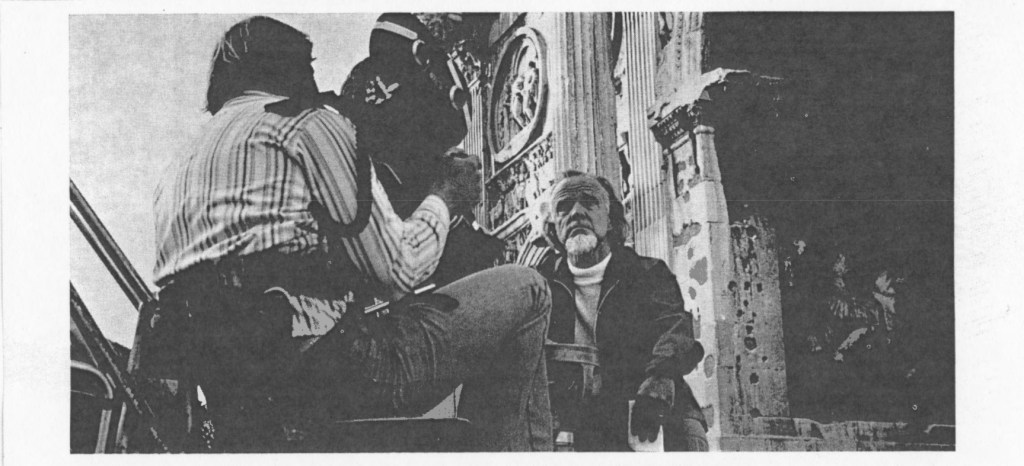
Francis Schaeffer filming on location, in an undated photograph by M. Arshad, printed in an advance brochure from Gospel Films. Box 41, folder “Notes—Betty Ford’s (2),” Betty Ford White House Papers, 1973-1977, Gerald R. Ford Presidential Library

After spending this summer on Francis Schaeffer’s film series How Should We Then Live, I ran out of time to write the final post before my autumn semester started. But there’s another reason I am concluding this rewatch series only now, after a hiatus of almost four months: I have been reluctant to face these last two episodes.

A prospectus for the final episodes of the series, from a brochure in Box 41, folder “Notes—Betty Ford’s (2),” Betty Ford White House Papers, 1973-1977, Gerald R. Ford Presidential Library

“The Age of Personal Peace & Affluence” and “Final Choices” are not historical discussions. They are responses to twenty years of current events, beginning with the failed Hungarian anti-Soviet uprising of 1956, which had made a deep impression on Francis Schaeffer when it happened. Much of the run time of these episodes, indeed, is dedicated to speculating about the future.

When Schaeffer mapped out these final episodes before production began, he designed them as a trilogy that would describe how drug use, affluence, and apathy had created a crisis: “Just as in ancient Rome,” western people in 1977 faced an imminent wave of authoritarianism without the spiritual tools to defeat it.

I’ve been reluctant to review these episodes, or even rewatch them, because I haven’t been sure I could do it without simply writing about contemporary evangelical politics in the United States.

Throughout this series, I have tried to keep my focus on Schaeffer’s historical claims about western civilization, or else on historical context that would be useful for understanding where those claims came from. These final episodes were sure to strain that commitment.

Moreover, all the fundamental elements of the argument presented in these episodes, as far as I could tell in advance, were already included in previous installments of How Should We Then Live. After all, I have been describing Schaeffer’s argument about a choice between “biblical” Christianity and political destruction since I wrote about the first episode. What more could I say about it now?

Concluding this series today, my solution to that problem is to turn How Should We Then Live inside-out. I plan to ask how its account of western society in the 1970s might shape views of that era today, now that we can treat the 1970s as a moment in history.

Continue reading “How Should We Then and Now: Eps. 9-10 (The Age of Personal Peace & Affluence, and Final Choices)”

Religious Hostility in Academia: A View from 2005

A story in the New York Times this weekend sent me back through the archives of World Magazine, looking for a 2005 article that played an important role in my journey into academia.

The Times story—headlined “His Reasons for Opposing Trump Were Biblical. Now a Top Christian Editor Is Out”—describes how Marvin Olasky, a former University of Texas journalism professor who also played a role in shaping the early domestic agenda of George W. Bush, seems to have lost control of an evangelical Christian newsmagazine that he has edited for more than a quarter of a century.

The cover stories of the April 30, 2005, issue were profiles of Pope Benedict XVI and Senator Rick Santorum

For complicated reasons, what this story dredged up for me is a memory of a specific pair of interviews that World ran under a single headline, sixteen years ago.

The headline of that article, published on April 30, 2005, was “Uncongeniality Contest.” The subhead was “Two views of elite academia from Harvard Law School.” I remember it vividly from my days as a subscriber. Going back to re-read it now, I find the article substantially as I remember it.

At the time, I was in my junior year of college at an evangelical university, preparing to apply to Ph.D. programs to study history. I took the article as an attempt to frighten me. (Not me individually, of course, but people like me.) It was one of countless messages I’d seen over the years warning that American secular institutions of higher education were comprehensively hostile to people like me.

But this time, I looked closely at the evidence provided, and what I saw was patently absurd.

Continue reading “Religious Hostility in Academia: A View from 2005”

Widely Debated and Currently Controversial

In the state of Texas, a new law took effect on September 1, limiting what public social studies teachers can teach. The bill passed in the state legislature on an almost perfect party-line vote.

Among other things, the law, House Bill 3979, mandates that in required courses,

a teacher who chooses to discuss [a particular current event or widely debated and currently controversial issue of public policy or social affairs] shall, to the best of the teacher’s ability, strive to explore the topic from diverse and contending perspectives without giving deference to any one perspective.

Today, NBC News has reported on the effect this law is having in the Dallas/Forth Worth suburb of Southlake, where the school district is already embroiled in a political battle over racism. The district’s curriculum director was recently recorded (surreptitiously) during a training session with teachers, acknowledging their fears about the law. She told them,

We are in the middle of a political mess. And you are in the middle of a political mess. And so we just have to do the best that we can. … You are professionals. … So if you think the book is O.K., then let’s go with it. And whatever happens, we will fight it together.

But she added, giving an example of a potential conflict,

As you go through, just try to remember the concepts of [H.B.] 3979, and make sure that if you have a book on the Holocaust, that you have one that has an opposing—that has other perspectives.

Teachers heard on the recording reacted with shocked disbelief, speculating that this directive would apply to a book like Number the Stars, a widely taught historical novel about a Jewish family in Nazi-occupied Denmark.

She said, “Believe me, that’s come up.”


EDIT: On social media, many people have been attacking the administrator for supposedly suggesting it could be legitimate to present students with “opposing” sides on the Holocaust. I think they probably have misinterpreted what happened here.

Southlake has been at the center of a very public controversy over racism at its high school. That is presumably why NBC News was provided with this audio recording in the first place; NBC has been covering this situation in depth. In this context, Southlake school district is likely to have been targeted by far-right extremists; that’s how the world often works today.

In the audio released by NBC, the curriculum director is heard clearly indicating that she finds H.B. 3979 outrageous, committing herself to support teachers when they choose to teach controversial books. But she also provides teachers with strategic advice for protecting themselves against the law.

Because the text of H.B. 3979 does not discriminate against far-right extremist ideas.

In my reading, it is significant that the curriculum director corrected herself when she started to talk about supplementing the curriculum with “a book that has … an opposing” perspective on the Holocaust, switching to “a book … that has other perspectives” on the Holocaust.

Remember the actual language of H.B. 3979: When a teacher discusses a controversial social studies topic, they must “explore the topic from diverse and contending perspectives without giving deference to any one perspective.” Given that language, teachers targeted by extremists would be providing themselves with legal cover for teaching the Holocaust truthfully if they could find “diverse and contending perspectives”—which could mean a lot of things other than Holocaust denial or approval—to include in the discussion.

And given Southlake’s recent history in the public eye, I’m inclined to believe the curriculum director, at least in a general way, when she says this issue has “come up” already.

I certainly hope that any court would rule that the Holocaust does not qualify as a “widely debated” topic. (“Currently controversial,” unfortunately, would include, by definition, virtually anything that resulted in a teacher being targeted.) But teachers and school districts do not have infinite resources for going through the process of finding out how courts will rule when they interpret bad laws.


A second EDIT to add: It is also worth understanding the internal dynamics of Southlake’s school district, to the extent they are publicly known.

The Dallas Morning News and the Forth Worth Star-Telegram report that a fourth-grade teacher there—a Carroll ISD 2020 “teacher of the year,” in fact—was recently the target of political harassment for having in her classroom a book called This Book Is Anti-Racist. The politicians on the school board—including two who had received donations from the parents’ PAC who complained—voted to reprimand the teacher for doing her job. In making this decision, the politicians were overruling the school administration, who had investigated the complaints and had cleared the teacher of wrongdoing.

In an environment like this, for anyone to attack a school administrator for trying to protect teachers against political harassment, as the curriculum director in the most recent controversy did, is to compound the chilling effects of Texas law, making it more dangerous to be a history teacher in Texas, not less.

A Case for Trusting Human Nature

Jonathan Marks’s new little book Let’s Be Reasonable: A Conservative Case for Liberal Education (Princeton University Press, 2021) is flawed but important.

It is flawed partly because its conception of liberal-humanistic education seems to be almost exclusively a Great Books model, which offers a limited view of what higher education should encompass. The book is important, on the other hand, because it’s written primarily, though not exclusively, to Americans who think of themselves as political conservatives, and it asks them to defy their own movement’s leaders by supporting, and generally having faith in, American colleges and universities.

I say Marks addresses readers who “think of themselves” as conservative because it’s not always clear how much practical common ground he has with the Trump-era conservative political movement, despite repeatedly declaring himself to be a conservative in this book and despite writing for well-known conservative publications including Commentary and the Weekly Standard over the years. A lot of self-declared conservative academics have that problem in 2021.

But nevermind: I know with some certainty that an audience exists for this book on today’s American right, however small a part of the conservative political coalition these readers may be. Likely readers include conservative high schoolers and new undergraduates—and their parents—who should definitely read this book as a counterweight to the massive stacks of books and articles that explicitly aim to terrify them.

Speaking to conservatives’ anxieties, Marks argues—correctly—that recent commentators have largely misrepresented what U.S. college campuses are like. College campuses, he writes, can be overwhelmingly left-leaning without being a stifling atmosphere for conservatives like him. (A full professor, he chairs the department of politics and international relations at Ursinus College.) Colleges are committed to rational discussion, and this means they have great potential for liberating minds. And pundits’ claims that millennials and Gen-Z undergraduates are intolerant little wilting orchids? They sound, to Marks, almost exactly the slurs older people cast upon the youth of his generation.

Let’s Be Reasonable asks readers to have faith in human nature: in the willingness of students and professors alike to answer the call to engage in rational discourse for the sake of rational discourse, trusting that it will have a freeing effect on the conversation’s participants.

Five Weeks On

Caution: This swinging door on campus engages in positive self-talk.

I can’t say this has been my least stressful semester of teaching.

On one campus, my very first class period was interrupted by a tornado warning. Later, I learned that an EF-3 tornado had been leveling a neighborhood five miles away from our classroom. On another campus, major flooding from the remnants of Hurricane Ida shut down freeways during my morning commute, turning an hourlong trip into a three-hour tour of various neighborhoods. (And then I had to figure out how to get back home that night.)

A few days later, a driver who couldn’t tell where the lanes were—because the state apparently hasn’t been maintaining roads at all during the past two years—hit the side of my car as we tried to exit one of those same freeways. Nobody was hurt, and we were both able to drive home, but I can’t say the accident reduced my anxiety about knowing that American roads, per mile traveled, are 24% deadlier than they were before the pandemic.

Indeed, homicidally reckless behavior is routine on the roads here. On Friday, for only one example, a driver followed me for two miles on the freeway with her headlights switched off, half an hour before dawn. Nighttime stealth driving actually isn’t unusual in this region; a typical week furnishes me with more than one example. Such motorists, as foolish as they are, scare me far less than all the drivers who seem determined to vent their social aggression at high speed in heavy traffic, day after day. There is not a doubt in my mind that their behavior is worse than it was before the pandemic.

So far, meanwhile, I have taught COVID-positive students in at least two classes without getting a symptomatic infection. The first time, this caused considerable anxiety because I developed what I now assume was an unusually bad case of nasal allergies around the same time. (I eventually tested negative for COVID. To get my test, I had to drive past road crews that were cutting down broken trees along the path of the tornado.) The second time I learned about a student’s positive test, I barely thought about it, given everything else going on.

Maintaining any topical continuity in my classes this fall, of course, has been nearly impossible due to high absenteeism, as students are forced to quarantine or deal with all the other things that seem to be breaking in American society right now. And in most weeks, I have had almost no prep time between classes, given my commute. That, too, dramatically degrades the quality of the instruction students are getting.

All in all, this semester feels apocalyptic in a way few ever have before.