

One of my mostly unstated purposes in teaching history courses is to honor the courage it has always taken to live in the world.
(Content warning: This post discusses suicide.)
One of my mostly unstated purposes in teaching history courses is to honor the courage it has always taken to live in the world.
(Content warning: This post discusses suicide.)
Hot contention, raucous argument, and loud protestation cannot kill a state’s educational future. Only calm indifference, self-satisfied silence, and the deadly quiet negative will do education in. We can afford to make proper concessions among conflicting interests, formulary compromises among educational purposes, and fiscal adjustments in the name of sound economy in the state. But one big fact should be kept straight: for popular ignorance, for a state’s undereducation, there can be no price but public ignominy.
— Harry Huntt Ransom, “Educational Resources in Texas,” 1961[*]
[*] The Conscience of the University and Other Essays, ed. Hazel H. Ransom (Austin: University of Texas Press, 1982), 19.
Part 1: Design Fundamentals
This is the first installment of a series designed to help historians use Microsoft PowerPoint effectively in the classroom. (You may want to read the series introduction first.)
Today, I’m writing about the big picture of PowerPoint design. This post is about how to set up a slideshow to communicate in the classroom (or conference hall) clearly and effectively. It’s not really about the technology, per se—at this stage, we’re just talking about how to build a visual communication element into a history talk.
As you design your presentation, you should keep three core principles in mind:
Let’s face it: If you teach or make other kinds of history presentations, you probably use PowerPoint.
Microsoft’s presentation slideshow software is more than thirty years old. It’s a standard piece of classroom technology. Students expect it. Instructors rely on it.
Yet many of us are sheepish about it. We complain about presenters who simply read their slides aloud. Some teachers warn that relying on PowerPoint is dangerous; a good professor, they say, can walk into any classroom and teach no matter what technology is available that day. Many claim the premise of PowerPoint is flawed because the lecture itself is an outdated teaching method. Also, a lot of presentations are really ugly.
There is some merit to all of these complaints. And there are other slideshow software programs on the market. But the chances are good that if you’re teaching history, you’re using PowerPoint anyway.
There are good reasons for that. PowerPoint is an excellent tool.
I learned some of PowerPoint’s virtues the hard way in my first training-wheels-off teaching job. Hired at the very last minute for a U.S. history survey, I hit the lectern before I even had a university email account or network login—and without the opportunity to assign books ahead of time. My students were lost for the first few days, my printed handouts notwithstanding. PowerPoint, when I could finally access the classroom computer, probably saved the course.
Lately, on course evaluations, students leave me a surprising number of comments like these:



I’m certainly not claiming that PowerPoint is the only way to present history. But it can be a powerful way. Contrary to some critics’ expectations, using it effectively means more than simply projecting text on a screen. To use PowerPoint well is to design a more immersive narrative for your course. And your PowerPoint slides don’t have to be ugly, either.
In this series of posts, I plan to explain some of the things I’ve learned about using PowerPoint in history classes. Some of what I have to say is very practical–it’s about avoiding basic technical hiccups. Some is about graphic design. Some is specifically about using PowerPoint to craft a story and exhibit historical evidence.
Tomorrow, in my first post, I’ll begin with a few fundamental principles.
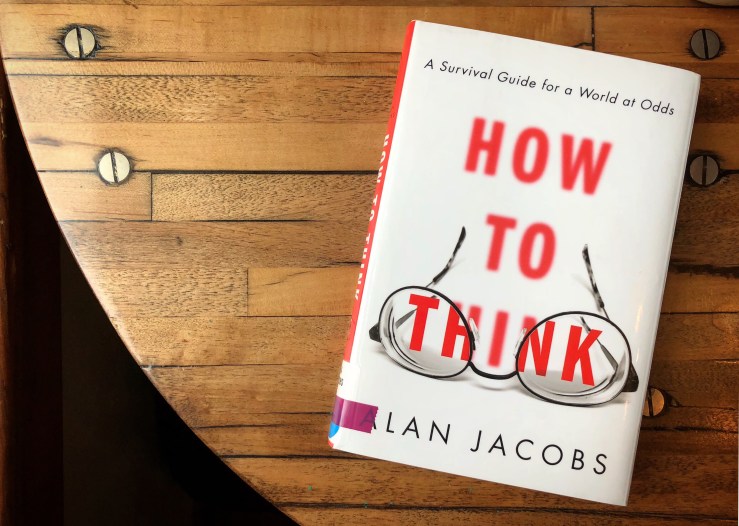 Alan Jacobs’s little book How to Think, published last year, draws an interesting contrast between “academic life” and “teaching”:
Academics have always been afflicted by unusually high levels of conformity to expectations: one of the chief ways you prove yourself worthy of an academic life is by getting very good grades, and you don’t get very good grades without saying the sort of things that your professors like to hear.
So again, no, academic life doesn’t do much to help one think, at least not in the sense in which I am commending thinking. It helps one to amass a body of knowledge and to learn and deploy certain approved rhetorical strategies, which requires a good memory, intellectual agility, and the like. But little about the academic life demands that you question your impulsive reactions ….
Being a teacher, though: that’s a different thing. I have been teaching undergraduates for more than thirty years now, and generally speaking undergraduate education is a wonderful laboratory for thinking. Most of my students know what they believe, and want to argue for it, but they also realize that they still have a lot to learn.[*]
This provocation deserves some pondering.
If one lives in exile, the café becomes at once the family home, the nation, the church and parliament, a desert and a place of pilgrimage, cradle of illusions and their cemetery …. In exile, the café is the one place where life goes on.
– Hermann Kesten (1900-1996)[*]
_______________
[*] Quoted in George Prochnik, The Impossible Exile: Stefan Zweig at the End of the World (New York: Other Press, 2014), 170.
 Blue Book Diaries