“Finding New Angles at Which to Enter Reality”

It should be said, first of all, that description is itself a political act. … Writers and politicians are natural rivals. Both groups try to make the world in their own images; they fight for the same territory.

— Salman Rushdie, “Imaginary Homelands,” London Review of Books (Oct. 7, 1982)

“It’s Made Me a Very Proud German”

In this short video, Katharina Matro, a high school teacher who works in Maryland but grew up in Germany, reflects on the benefits of confronting hard truths about the national past. The video was recorded for the American Historical Association’s “Teaching History with Integrity” project.

Matro refers in this video to a great line in the 2020 memorial address by Frank-Walter Steinmeier, the president of Germany: “This country can only be loved with a broken heart.”

History’s Half-Finished Sentences

The heroes of history are so decked out by the fine fancy of the professed historian; they talk in such measured prose, and act from such sublime or such diabolical motives, that few have sufficient taste, wickedness, or heroism, to sympathise in their fate. Besides, there is much uncertainty even in the best authenticated ancient or modern histories; and that love of truth, which in some minds is innate and immutable, necessarily leads to a love of secret memoirs and private anecdotes.

We cannot judge either of the feelings or of the characters of men with perfect accuracy, from their actions or their appearance in public; it is from their careless conversations, their half-finished sentences, that we may hope with the greatest probability of success to discover their real character.

— Maria Edgeworth, author’s preface to Castle Rackrent, 1800 (paragraph break added for clarity)

Space for Thinking, Space for Acting

Campuses are complicated spaces, because they aren’t just one kind of space: There’s the classroom, the dorm, the public space that is the campus. Then there’s what we could call clubs, support centers—identity based or based on social categories or political interests. It’s a terrible mistake to confuse all of these and imagine that the classroom or the public space of the campus is the same as your home. …

Academic freedom needs to be appreciated as a collective right of the faculty to be free of interference in determining what we research and teach. We’re accountable to our disciplines, our peers. We can’t just do anything and have it called quality scholarship or teaching. But the idea of academic freedom is that we are free of external interference. Free speech is different. It’s an individual right for the civic and public sphere. It’s not about research and teaching. It’s not even about the classroom. It’s what you can say in public without infringement by others or the state. ….

[I]f we just focus on this generation’s political style—and we have to remember youth style always aggravates the elders—we ignore their rage at the world they’ve inherited, and their desperation for a more livable and just one, and their critique of our complacency. That is part of what is going on in the streets and on our campuses. But that remains different from educating that rage and helping young people learn not just the deep histories but even the contemporary practices that will make them more powerful thinkers and actors in this world. If they’re right about our complacency, what we still have to offer is knowledge and instruction and some space in a classroom to think.

Wendy Brown, interviewed in “Why Critics of Angry Woke College Kids Are Missing the Point,” New York Times Magazine, May 1, 2022

If Neutral History Existed, No One Would Read It

The myth of neutral history is just that: a myth. If it actually existed, no one would want to read it. Every historian brings to their subject-matter a raft of experience, opinions, attitudes and assumptions that inform their perceptions, and influence both the issues they find interesting, and the questions they bring to their material. History is an attempt to discern the patterns that underlie the surviving traces of the past, not a bloodless chronicle of patternless events, and the interpretation of the records of the past demands personal gifts like imagination and empathy. 

—Eamon Duffy, “‘The Stripping of the Altars,’ 30 Years On,” abridged introduction to the new edition, Catholic Herald, March 30, 2022

Who Supports Teaching U.S. History in Public Schools?

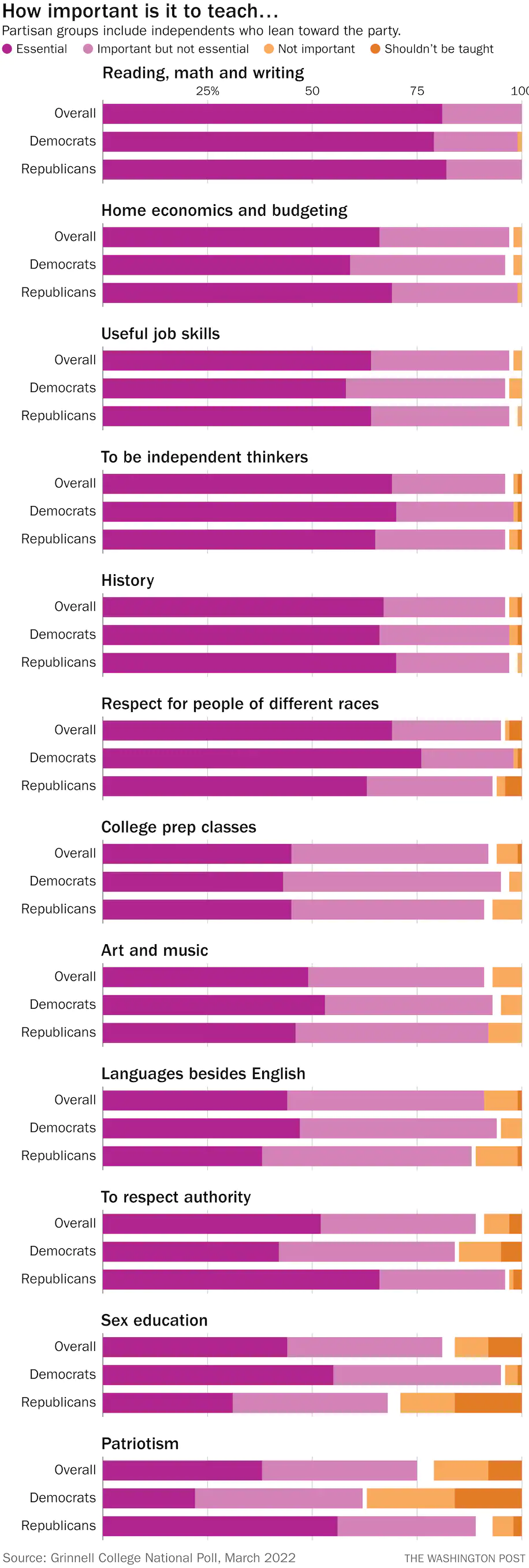
An infographic prepared by the Washington Post, labeled "

In the Washington Post yesterday, the data journalist Philip Bump highlighted some results of a March 2022 edition of the Grinnell College National Poll. His article focuses on respondents’ views of what should be taught in American public schools.

The poll shows that Republicans and Democrats differ significantly in their level of expressed support for (in particular) sex education and attempts to instill patriotism—though clear majorities in both parties actually say they support both. Thus, the current headline, “Democrats want to teach kids sex education. Republicans want to teach them patriotism”—is misleading, though it’s grounded in truth.

What caught my eye was the entry for history.

Unsurprisingly, strong majorities in both major parties believe that public schools should teach history. But I couldn’t help noticing that support for teaching history was ever-so-slightly lower among Democratic respondents.

That’s consistent with what another major survey found in 2020: American conservatives were more likely than liberals (92% to 84%) to say that teaching U.S. history to children is very important, and they’re also more likely (44% to 30%) to say they wish they’d had more American history courses in school.

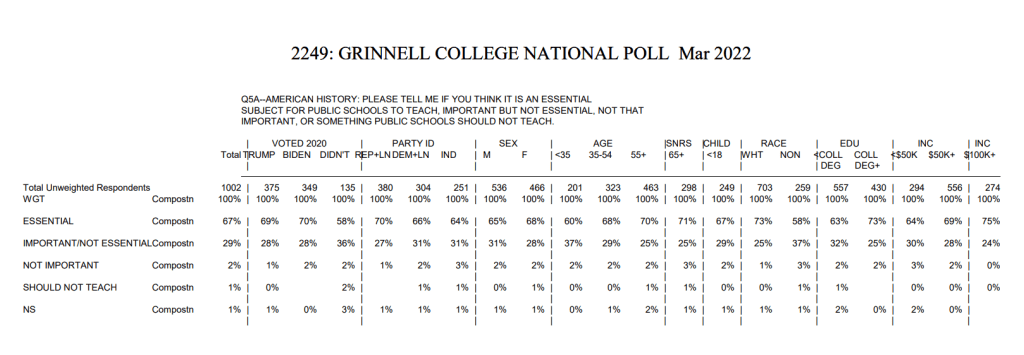
Curious, I dug up the new Grinnell poll’s topline results.

I found that this poll, too, actually asked about American history, not history in general. And interestingly, although there was slightly lower expressed support for teaching U.S. history among Democrats than among Republicans, there wasn’t any significant difference between 2020 Trump and Biden voters.

Data table for Question 5A in the Grinnell College National Poll for March 2022. The question is: "American history: Please tell me if you think it is an essential subject for public schools to teach, important but not essential, not that important, for something public schools should not teach."

What conclusions should we draw from this? I really have no idea. Probably, we shouldn’t draw any conclusions at all. Anyway, all the potent debates of our moment are about what should be taught in public schools as American history, not whether American history should be taught.

But I know that if I ever see support for teaching U.S. history in public schools drop significantly, among either Democrats or Republicans, I’ll have a new big thing to worry about.

Qualities and Events in Storytelling

Values are the soul of storytelling. Ultimately ours is the art of expressing to the world a perception of values.

For example, alive/dead (positive/negative) is a story value, as are love/hate, freedom/slavery, truth/lie, courage/cowardice, loyalty/betrayal, wisdom/stupidity, strength/weakness, excitement/boredom and so on. All such binary qualities of experience that can reverse their charge at any moment are Story Values. …

Look closely at each scene you’ve written and ask: What value is at stake in my character’s life at this moment? … If the value-charged condition of the character’s life stays unchanged from one end of a scene to the other, nothing meaningful happens. The scene has activity—talking about this, doing that—but nothing changes in value. It is a nonevent.

—Robert McKee, Story: Substance, Structure, Style, and the Principles of Screenwriting (New York: It Books, 1997), 33-36

God’s Not Dead, Just Away at College

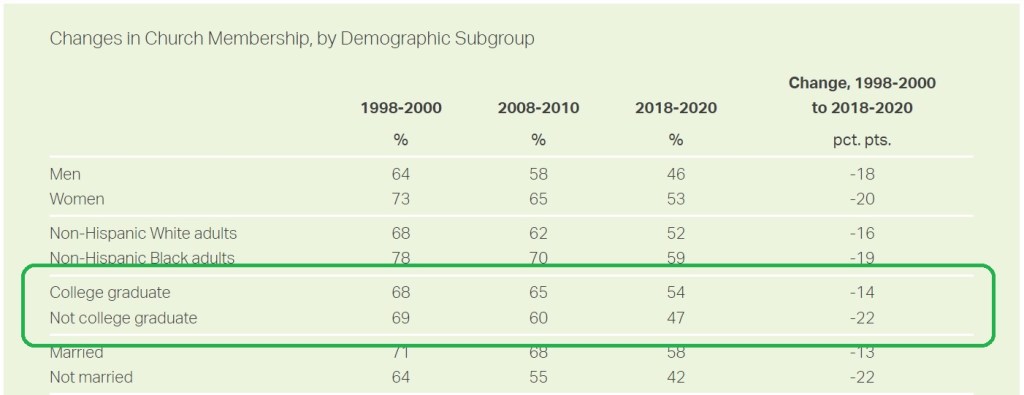
Briefly noting this item from March 2021: Contrary to conventional wisdom, having a college degree makes an American substantially more likely to say they belong to a church, synagogue, or mosque. That’s according to Gallup surveys that have tracked religious affiliation over time.

Edited chart provided by Gallup

The religious affiliation gap between college graduates and non-graduates, which didn’t exist two decades ago, appears to be widening rather than closing.

As I’ve tried to show here at Blue Book Diaries many times, the conventional wisdom about higher education’s ideological effects in the United States is profoundly broken. That is due in no small part to the work of cynical pundits and professional surrealists, many of whom were happy to receive the benefits of education at elite universities themselves.

The relationship between higher education and religious belief is complicated, but simplistic narratives about supposed religious hostility and atheism in college don’t capture the typical American student’s experience.