Week Links in Education: Nov. 12

Some of the stories and essays, particularly related to education in the United States, that caught my attention this week. A πŸ•› symbol indicates a known metered paywall. A ⏳ symbol indicates availability for a limited time.


Sold a Story is a true crime podcast about how education consultants killed American reading skills.

A middle school in Pasadena now bears the name of its most famous student. Nadra Nittle tells the story of Octavia E. Butler Magnet.

A college student once asked Octavia Butler how to stop the catastrophes her fiction prophesied. She had good news and bad news.

Last weekend, the Thomas Cooley Professor of Ethical Leadership at New York University’s Leonard N. Stern School of Business; and the Richard and Frances Mallery Professor of Law and director of the Constitutional Law Center at Stanford University; and a professor emeritus of psychology at the University of Toronto who has six million YouTube subscribers; and the Robert Mundheim Professor of Law at the University of Pennsylvania; and the John Marshall Harlan II Professor of Law Emerita at New York Law School held an invitation-only event in the Bay Area to talk with Peter Thiel about what it’s like to be silenced πŸ•› in academia.

Contrary to myth, college improves other students’ opinions of evangelical Christians.

Gender bias in student evaluations of teaching worsens πŸ•› over time.

When schools around Boston lifted their mask mandates, it led to an extra 45 covid cases per 1,000 students and workers during the next four months.

Promising that “Oklahoma won’t go woke,” the state superintendent of education, now elected for a full term by voters, has a plan for history teachers.

American historians may not be able to end nationalism through their work, argues Eran Zelnik, but it’s also a mistake to think they can tame it.

In Kansas, someone pledged a matching gift of up to $500 million if McPherson College can raise $250 million by June. It would be the largest-ever single donation to a small liberal arts college.

In my day, Batman: The Animated Series was essential after-school and weekend viewing. Kevin Conroy, the voice of Batman, died this week at the age of 66.
Week Links in Education: Nov. 5

Some of the stories and essays, particularly related to education in the United States, that caught my attention this week. A πŸ•› symbol indicates a known metered paywall. A ⏳ symbol indicates availability for a limited time.


Three weeks after claiming he knew of a school that installed a litter box for a furry, Joe Rogan admitted it wasn’t true.

Last week’s NAEP scores don’t reflect an educational emergency, writes πŸ•› Jay Caspian Kang. They expose Americans’ fear that our children will live worse than we did.

Across the University of California system, UAW locals representing 48,000 academic workers voted to authorize a strike.

Collin College, a noted bastion of free speech, has settled with a professor it fired for saying she worked there.

The U.S. Department of Education plans to make life easier for student borrowers.

The Supreme Court heard arguments in cases that will let the Republican majority ban race-conscious college admissions.

About half the respondents in a recent survey think the Dobbs ruling will influence where they go to medical school.

Do America’s K-12 teachers believe civics education should be “content-free”? Rick Hess is worried πŸ•› about a RAND study.

To break a strike, the government of Ontario plans to fine teachers $4,000 per day.

In Brazil, many young people see the presidential victory of Luiz InΓ‘cio Lula da Silva as a win for education.

Adele wants to study English literature. That makes sense, writes Andrea Busfield. By the way, you’re saying her name wrong.

In Arizona, the future of public education is the one-room schoolhouse.

Anxiety doesn’t make you worse at taking tests, according to research on German medical students. But it does interfere with studying.

The outcome of America’s nationwide elections on Tuesday could hinge on relatively inactive voters who care deeply about local education.

Thin Margins

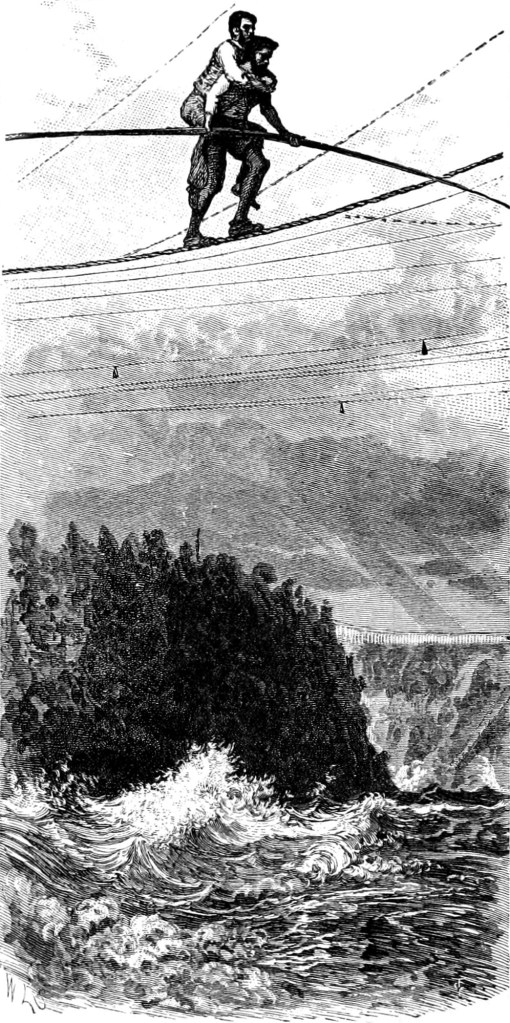
A bearded tightrope walker carries another man high above raging water

There’s good news, in the first place. This academic year is much better than last year was at the same point. For me, anyway. And for most of my students and friends.

We may be living every day under apocalyptic headlines about the world at large, but the apocalypse isn’t happening inside my classrooms. Not this time. Not as far as I know. Though everybody has their own struggle.

With mask mandates lifted almost everywhere, newly matriculated college students now get to see each others’ faces on campus. For most students and most professors, that’s been a great thing for morale and probably, on the whole, for learning, whatever it means for physical health. (I’m not going to deny the tradeoffsβ€”in either direction.)

But everybody’s working on thin margins. Teachers and students alike. There’s less room for error than there was at this time three years ago. We have lower reserves of energy, creativity, health, wealth, and patience.

Patience is the problem that’s really on my mind lately.


For me, the problem of patience has been brought into clearer focus by what’s happening on Twitter.

Continue reading “Thin Margins”

Week Links in Education: Oct. 29

I’m going to try to start compiling some of the stories and essays, particularly related to education in the United States, that catch my attention each week. Linking does not necessarily imply endorsement. This is an experiment that will be abandoned if it bores me.

A πŸ•› symbol indicates a known metered paywall. A ⏳ symbol indicates availability for a limited time.


This summer, a Koch Industries executive became the president of Emporia State University. A month later, ESU began firing tenured professors. Was it a political purge?

In Germany, states that let 16-year-olds vote see higher turnout among 20-somethings, too.

The AHA’s annual awards in the field of teaching recognized Zachary M. Schrag (George Mason University), Katie Stringer Clary (Coastal Carolina University), Mary Institute and Saint Louis Country Day School, and Orli Kleiner (Brooklyn Technical High School). Nominations for next year’s awards should be submitted to the American Historical Association by May 15, 2023.

Jeanne Theoharis gathered middle- and high-school teachers to come up with lessons related to The Rebellious Life of Rosa Parks.

“Right now,” says the Uvalde teacher falsely accused of leaving open a door, “I’m lost.”

A man from Alabama posed as a pre-med student (’25) at Stanford for the last year and a half.

“The problem isn’t that [the academic canon wars] went too far”, writes πŸ•› John Michael ColΓ³n. “It would be better to say that they stopped too soon.”

This week, the artist sometimes known as Kanye West may or may not have closed his Donda Academy, sometimes known as a school.

The Prevent surveillance program, which targets Muslims in British schools and universities, violates European law, according to an NGO report issued this week.

The new season of Slate’s podcast One Year focuses on 1942. This week, “The Year Everyone Got Married” ⏳ profiles Millie and Leo Summergradβ€”along with nearly two million other couples who married, often right out of school, as young Americans went off to war.

College football and traumatic brain injury: What did the NCAA know, when did it know it, and why have the records disappeared?

About those fallen NAEP reading and math scores, says πŸ•› Jay Wamsted, “I cannot stress the level to which I do not care.”

Revising for Clarity and Brevity: A Worksheet Activity

This week, in a course for new college students, I decided to bring out one of my all-time favorite writing activities. This exercise has proven particularly effective for first-year students, especially if they’re reasonably comfortable writers already. It’s a strangely fun activity designed to teach a critical part of editing: cutting unnecessary words and simplifying complex phrases.

I distributed a worksheet with a single 26-word sentence on it.

This sentence came from a highly regarded historical monograph. It was written by a distinguished historian and released by a major university press. I won’t identify the source here because I have no desire to shame this author in public. As I told my students, it’s a great book. It’s just unnecessarily hard to get through.

I chose the sentence partly because it has some obvious redundant languageβ€”unnecessary complexity that many readers can spot quickly when they think about it.

The worksheet I distributed looked sort of like this:

Continue reading “Revising for Clarity and Brevity: A Worksheet Activity”

Retrovisibility: A PowerPoint Template for History Classes

This post has been updated (April 28, 2023) with a link to version 1.0 of the template.

Almost a decade ago, I designed a PowerPoint template for use in my history courses. This summer, I rebuilt it from the ground up. Among other improvements, the new version of the template incorporates a new open typeface from the Braille Institute of America, Atkinson Hyperlegible, which should improve readability across different contexts.

I have decided to make this improved design available to other instructors and students under a Creative Commons license. I named the template “Retrovisibility.” It’s designed for the PC version of Microsoft’s PowerPoint desktop software.

Continue reading “Retrovisibility: A PowerPoint Template for History Classes”

How We Talk about Heroes with Feet of Clay

Earlier this week, near the end of class in my modern U.S. survey, an undergraduate student posed a provocative and timely question: Why do we only want to talk about the good things people from history did, and not the bad things? I think the wording was pretty close to that, though I don’t recall exactly.

In the context of the lesson, the student’s question was about public monuments, and specifically the colossal presidential faces of the Mount Rushmore National Memorial. (My student particularly mentioned George Washington’s slaveholding as an example of an inconvenient truth about a historical figure.) But the question also seemed to voice a complaint about the student’s experiences in K-12 education.

We were about to run out of class period, so we tabled this question for the next lesson.

I wanted to make sure we discussed this question properly because a lot of the students in this class are education majors. Whether or not they specialize in social studies, they’ll soon be dropped into a public maelstrom centered on this problem. And many of them will have to decide how they are going to teach children responsibly about flawed figures from America’s past.

Discussion backdrop with detail from a photograph by Sergio Olmos, via OPB

To set up the conversation at the beginning of the next class period, I looked up a story from two years ago.

In October 2020β€”on the weekend before the federal holiday that Oregon would later designate as Indigenous Peoples Dayβ€”some two hundred people in Portland participated in an “Indigenous Peoples Day of Rage.” By the end of that night, some of the protesters had pulled down statues of Theodore Roosevelt and Abraham Lincoln, defaced a mural of the Lewis and Clark expedition, and smashed windows at the Oregon Historical Society, accusing that organization of “honoring racist colonizer murderers.”

I focused on this story becauseβ€”much more than the recent destruction of some other kinds of monumentsβ€”it presents us with legitimately challenging questions about public memory. (We’re toppling Lincoln now? Really?)

It also involves a specific atrocity I discussed in the last class period. Painted across the plinth of the Lincoln statue in Portland that night in 2020 were the words “Dakota 38”: a reference to Abraham Lincoln’s approval of the public mass execution of 38 prisoners after the U.S.-Dakota War in Minnesota in 1862. The statue’s hand was also painted red, presumably to signify Lincoln’s guilt as the Dakotas’ murderer. He had authorized, notoriously, the largest mass execution in U.S. history.

Basically, I didn’t want to make this conversation too easy. If we wanted to talk about hard truths, we should talk about hard truths, not easy ones. Thus, to begin our discussion in the following class period, I displayed a photograph taken that night in 2020 by the Portland journalist Sergio Olmos, and I briefly explained the story of the protest.

Then I posed two questions for the whole class. First, if you agree with the premise of your colleague’s questionβ€”that we usually want to talk about only the good, and not the badβ€”why do you think we’re like that? Second, how can we do better when we talk about our past?

The ensuing conversation lasted half an hourβ€”a substantial portion of our total class time.

Out of an abundance of caution about protecting my students’ privacy, especially considering the political sensitivity of the discussion, I won’t go into the details of what they contributed. But I can tell you for sure that this issue has been on the minds of some of these students.

They are keenly aware that it’s a hot political topic. They understand that politics directly shapes what K-12 teachers can safely say about American history at work. And they already have strong opinions about this, opinions they have formulated with considerable careβ€”in most cases, I’m quite sure, before arriving in my classroom.

Even though I’m being discreet about the contents of this class discussion, I’m writing about this because I think it’s important for American citizens who aren’t attending our colleges and universities to understand that these conversations are happening. It’s also important to understand that students are often coming to their own conclusions before they arrive in the college classroom.

And sometimes, correctly or not, they believe they’re reaching these conclusions in spite of the way they’ve been taught in primary and secondary schools, as much as because of it.

A New Career for History Majors

Many American humanities professors are worrying about evidence that students are avoiding us. Partly due to the extreme cost of a typical college education today, combined with the economic insecurity of our younger middle class, undergraduates are not only deciding not to major in humanities disciplines like history, butβ€”even more worryinglyβ€”are also likely more likely than college graduates in other fields to regret their choice later if they do.

Into this darkness comes a sudden ray of hope: a brand-new career opportunity for history majors. And it’s lucrative!

I think we can expect a rebound in history enrollments once young people realize that studying history can prepare you very well to compete for a rewarding job as the king of England.

I discovered this recently when I heard a BBC radio report that mentioned that the newly elevated Charles III studied archaeology at Trinity College, Cambridge, in the 1960s. Looking into this, I found that Charles had indeed studied archaeology and anthropology at first, but had switched to history for the latter part of his time at Trinity.

Now, I’m not exactly an expert on how subject examinations work at Cambridge, but as I understand it, this meant Charles’s baccalaureate degree was indeed a B.A. in history when he earned it in 1970.

In any case, that’s how the New York Times reported it at the time. Describing “the first university degree to be earned by an heir to the British crown,” the Times noted the following:

The degree awarded, based on examination results, was an honors degree in history, Class 2, Division 2. That is about the average at Cambridge β€” ‘a good middle stream result,’ as one don put it.

There are three classes of honors degrees, awarded according to grades, and the second class in turn has two divisions. …

The Prince’s tutor, Dr. Denis Marrian, senior tutor at Trinity, was asked whether Charles had been in any trouble as an undergraduate. ‘Nothing went wrong,’ was the reply. ‘In fact, I think you’ll find I have more hair now than I did three years ago.’

According to a recent story in the Guardian, the British monarch’s main income last year (the “sovereign grant,” a sort of royal allowance from the government), amounted to Β£86.3 million, or $98.2 million. That’s revenue derived from official wealth totaling an estimated Β£17 billion or so. (The crown owns expensive parts of London, much of the sea floor, the swans, etc.) In addition, the late queen had a private fortune estimated this year at Β£370 million; presumably much of that has passed to Charles III. Being the monarch also means significantly expanded access to housing in today’s tight market.

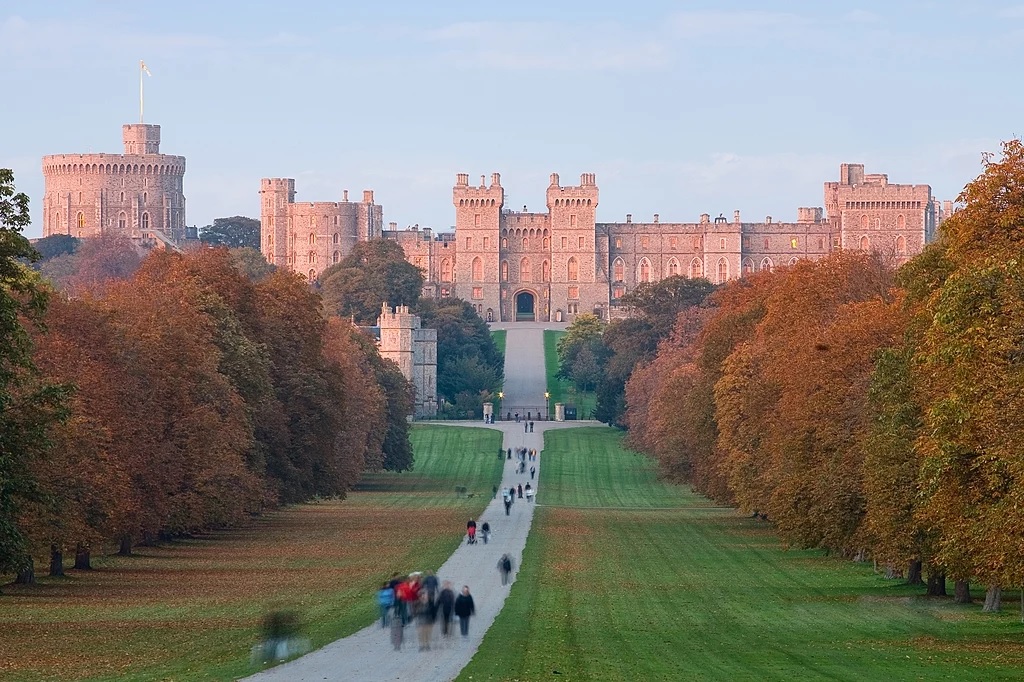
Seen at sunset: Just one of the exciting benefits of a career in history
Photo by David Iliff, 2006 (CC BY-SA 3.0)

I think we can all agree that this means a bachelor’s degree in history, even with only average grades, can be an excellent investment for a student’s future economic security. I trust American colleges and universities won’t overlook this crucial opportunity to publicize the value of what we do.

To be fair, though, it’s a career with limited opportunities for promotion.

A Democratic Rationale for Public Higher Education

It is not enough to see to it that education is not actively used as an instrument to make easier the exploitation of one class by another. School facilities must be secured of such amplitude and efficiency as will in fact and not simply in name discount the effects of economic inequalities, and secure to all the wards of the nation equality of equipment for their future careers. Accomplishment of this end demands not only adequate administrative provision of school facilities, and such supplementation of family resources as will enable youth to take advantage of them, but also such modification of traditional ideals of culture, traditional subjects of study and traditional methods of teaching and discipline as will retain all the youth under educational influences until they are equipped to be masters of their own economic and social careers.

β€” John Dewey, Democracy and Education: An Introduction to the Philosophy of Education (New York: Macmillan, 1916), 114

Class at a Historic Site: The Glassboro Summit of 1967

History, the Past, and Public Culture

Last year, the American Historical Association released the results of a detailed survey about how Americans interact with history. One finding caught my attention.

Nine in ten respondents indicated they trusted museums (90%) or historic sites (88%) either “some” or “a great deal” to convey “an accurate account of history”β€”compared with only three in four who said the same about college professors (76%) or high school teachers (70%). The intensity of their trust was striking, too: Respondents were three times as likely to trust museums or historic sites a great deal as to say the same about high school teachers.

Looking closer, I found something especially interesting. Historic sites, even more than museums, enjoy a distinctive level of trust among Americans who tend to be skeptical of other information sources.

For example, only 18% of Republican respondents said they placed a great deal of faith in college professors, whom they were just as likely not to trust at all. But 57% of Republicans said they trusted historic sites a great deal. Except for religious texts, in fact, historic sites were the only sources of historical information that Republicans were more likely to trust strongly than Democrats were.

A chart showing that 57 percent of Republicans, 47 percent of Democrats, 48 percent of independents, and 42 percent of people with no preference said they had "a great deal" of trust in historic sites.
Trust in historic sites as sources for “an accurate account of history,” by political party.
Fig. 45 in “History, the Past, and Public Culture,” 2021

These results suggest to me that historic sites may be uniquely important tools for engaging skeptical audiencesβ€”including, perhaps, earning the trust of students in high school and college.

Mulling this over, it occurred to me that skeptical Americans probably think of historic sites as primary sources. They may place greater faith in them because they sense that historic sites give them more immediate access to the past. (Of course, there are several other important factors in play, too, but let’s not overcomplicate the blogpost.)

This immediately focused my attention on a teaching idea I’d already had. And it brought together different aspects of my idea, which I now saw with new clarity. I suddenly got more serious about making a plan.


This autumn, I’m scheduled to teach a modern U.S. history survey course at Rowan University in southern New Jersey. As it happens, Rowan’s campus was the site of a high-level Cold War diplomatic meeting in 1967.

Press conference in front of Hollybush, from Rowan’s Glassboro Summit Collection

That summer, President Lyndon Johnson invited the Soviet premier, Alexei Kosygin, to speak with him at Hollybush, also known as the Whitney Mansion. That was the home of the president of what was then called Glassboro State College.

As you may already have guessed, this building still exists on campus.

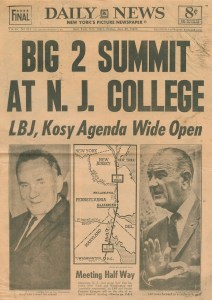
A newspaper front page in Rowan’s Glassboro Summit Collection

Usefully for my teaching purposes, the Glassboro Summit was not only local. It also involved several distinct topics of interest in this course, including nuclear disarmament, the Vietnam War, and the Six-Day War. Although Rowan’s summit was less immediately consequential than some others, therefore, it’s actually a pretty good window into the Cold War.

Today, the restored Hollybush mansion is maintained by Rowan University as a space for special events. So I’ve requested permission to hold class there one day this semester. And it now looks like I’ll be allowed to do it.

If my plan works, we’ll have an on-site discussion of primary sources related to the event. I’ll ask my students to read, view, or listen to those sources beforehand; furthermore, I’ll allow the students themselves to select some of the sources they’ll examine.

These primary sources may include:

Many of these sources are available through the Glassboro Summit Collection, a project hosted by the Rowan University Libraries Digital Scholarship Center. Before my class heads to Hollybush, therefore, I’m asking a DSC representative to come speak with us in our regular classroom about that collection.

If everything works, we’ll devote most of one class period to getting to know our digitized primary source collections, with help from a curator; then I’ll give students a few days to explore those collections on their own; and then we’ll convene in Hollybush to discuss what students have discoveredβ€”speaking together in the actual rooms where the summit took place.

I am pretty excited about this plan.